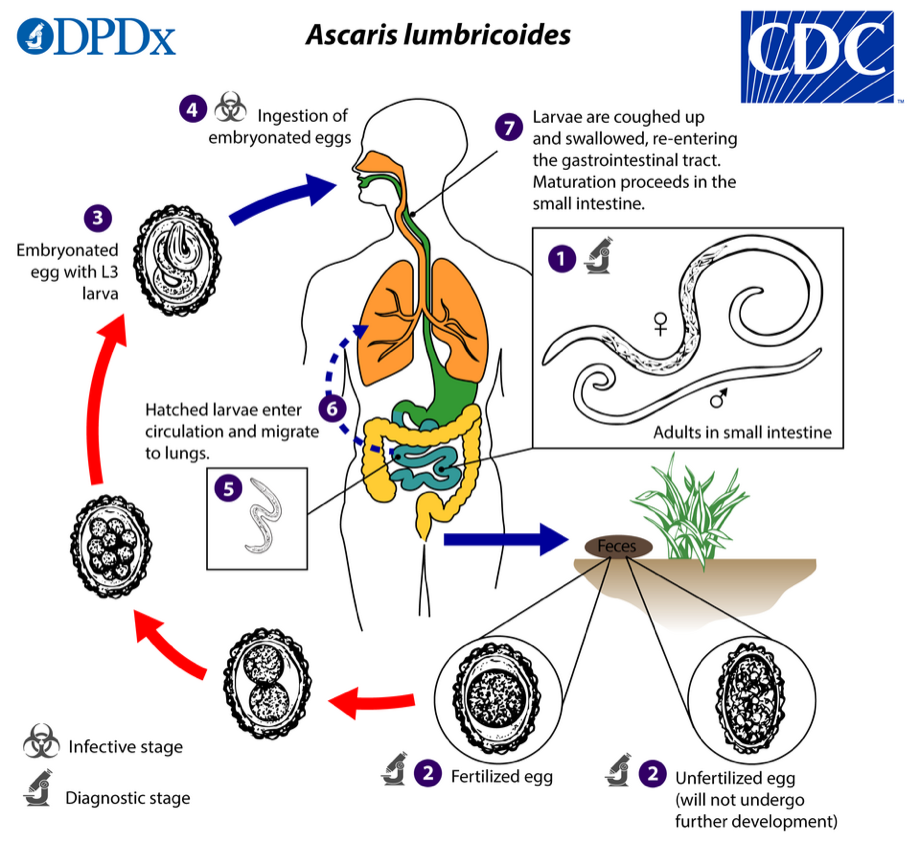
Parasites are organisms that live on or inside a host and draw nutrients at its expense. Here is what they actually are, how they get in, and the signs they can leave behind, explained plainly, without the scare tactics.
Life cycle of Ascaris lumbricoides: how a soil-transmitted roundworm gets in and completes its journey. Source: CDC · public domain
The basics
What are parasites?
A parasite is any organism that depends on another living thing, the host, for food and shelter, giving nothing useful in return. In humans they fall into three broad groups, ranging from single cells too small to see to worms several feet long.
Protozoa
Single-celled organisms
Microscopic, single-celled parasites that can multiply inside the body, sometimes from a single organism to a serious infection. They commonly target the gut and bloodstream. Examples include Giardia, Cryptosporidium, Entamoeba, and Plasmodium (malaria).
Helminths
Parasitic worms
Larger, multicellular worms visible to the naked eye as adults. Unlike protozoa they usually cannot multiply in their adult form inside the body, but a single worm can live for years and rob the host of nutrients. Examples include tapeworms, roundworms, hookworms, and flukes.
Ectoparasites
External organisms
Parasites that live on the surface of the body rather than inside it, feeding on skin or blood. They are also important because several of them transmit other diseases through their bites. Examples include lice, ticks, mites (scabies), and fleas.
Entry & survival
How parasites enter & survive
Most human parasites get in through a small number of well-understood routes, then settle in to feed and reproduce, often quietly enough that the host notices nothing for a long time.
How they get in
The main entry points are contaminated food and water (especially raw or undercooked meat and unwashed produce), direct skin contact with soil or larvae, insect bites from mosquitoes, ticks, and flies, and the fecal–oral route, in which microscopic eggs or cysts pass from stool to mouth via hands, surfaces, or food.
How they reproduce
Protozoa can divide rapidly inside the body, turning one organism into millions. Worms typically reproduce by shedding huge numbers of eggs into the host's stool, which then contaminate the environment and infect new hosts. Many have complex life cycles that move between humans, animals, soil, and water.
IMPACT ON THE BODY
Digestive system
Many parasites live in the intestines, where they irritate the gut lining and disrupt normal function, causing bloating, gas, diarrhea, constipation, or cramping.
Immune system
A chronic infection keeps the immune system on alert, which can drive ongoing inflammation, allergic-type reactions, and fatigue as the body diverts resources to fighting the invader.
Nutrient absorption
By feeding on the host and damaging the intestinal wall, parasites can compete for or block nutrients, leading to iron-deficiency anemia, vitamin shortfalls, and unexplained weight changes.
What to watch for
Common symptoms
Parasitic infections produce a wide range of signs, and they vary enormously between people and parasites. Crucially, almost all of these symptoms are non-specific: they overlap heavily with many other, far more common conditions.
Symptoms alone cannot diagnose a parasite
Every sign below has many possible causes. The only way to confirm or rule out a parasitic infection is proper testing. See our diagnosis & testing guide before assuming a parasite is the cause.
Unexplained fatigue
Persistent tiredness with no clear cause, sometimes accompanied by iron-deficiency anemia as parasites consume blood or nutrients.
Itchy anus at night
Intense night-time itching around the anus is the classic sign of pinworms, whose females lay eggs on the surrounding skin after dark.
Digestive issues
Bloating, excess gas, and alternating cycles of diarrhea and constipation are among the most frequently reported intestinal symptoms.
Weight changes
Unexplained weight loss, or difficulty gaining weight despite normal eating, can occur as parasites compete for the food you take in.
Skin issues
Rashes, hives, eczema, persistent itching, and even crawling sensations on the skin can be triggered by an immune response to parasites.
Sleep & teeth grinding
Disrupted, restless sleep and night-time teeth grinding (bruxism) have long been associated with intestinal parasites, especially in children.
Sugar & food cravings
Strong cravings for sugar and certain foods are commonly reported, thought to reflect both nutrient depletion and the parasites' own demands.
Joint & muscle pain
Aching joints or muscles with no injury or strenuous activity to explain them can be a sign of parasite-driven inflammation.
Brain fog & mood
Difficulty concentrating, memory lapses, anxiety, and mood changes are increasingly linked to chronic gut inflammation and the gut–brain axis.
Who is most at risk
Risk factors
Parasitic infection is far more about exposure than bad luck. The following factors meaningfully raise the odds, the more that apply to you, the more worthwhile a conversation with a clinician becomes.
Travel to endemic areas
Visiting regions where parasites are widespread, much of the tropics and subtropics, is one of the strongest risk factors.
Poor sanitation exposure
Limited access to clean water, safe waste disposal, or handwashing facilities dramatically increases fecal–oral transmission.
Pet & animal ownership
Cats, dogs, and livestock can carry parasites that pass to people through stool, soil, or close contact (zoonotic transmission).
Weakened immune system
People with compromised immunity, from illness, medication, or age, are more easily infected and more likely to develop serious disease.
Occupational exposure
Farm workers, childcare and healthcare staff, and others in regular contact with soil, animals, or waste face higher exposure on the job.
Raw or undercooked food
Eating raw or lightly cooked meat, fish, or shellfish, and unwashed produce, is a direct route for tapeworms, flukes, and roundworms.
Next steps
Not sure where you stand?
If any of this resonates, the two tools below are the best place to go next, both run privately in your browser and neither is a substitute for medical care.